ENERGY STAR® Canada
Government of Canada-endorsed mark for high-efficiency windows, doors, and skylights. Compare performance and select options that improve comfort and reduce energy costs.
Administered by Natural Resources Canada (NRCan)
Why ENERGY STAR® Matters
Better Comfort
Lower heat loss and drafts for improved year-round comfort
Energy Savings
Potential savings depending on your home and climate
Less Condensation
Improved resistance with the right glazing choices
Rebate Eligibility
May support eligibility for certain rebates and incentives
Key Performance Metrics
Understanding these metrics helps you compare products and choose the right configuration for your home.
U-factor (W/m²·K)
How fast heat escapes through the window or door.
Lower is better for keeping heat inside during winter. Look for U-factors below 1.4 for excellent performance.
Energy Rating (ER)
A Canadian composite metric for windows only.
Higher is better Balances U-factor, solar gain (SHGC), and air leakage for typical Canadian use.
Solar Heat Gain (SHGC)
Fraction of the sun's heat that passes through glass.
Higher or Lower depends on your needs Lower reduces summer overheating. Higher helps passive gains on sun-facing windows in winter.
Visible Transmittance (VT)
How much daylight passes through the glass.
Higher is brighter Lower can mean darker tints or triple-pane stacks.
Door Performance Note
Doors are categorized by glazing level: opaque, ≤50% glass, and >50% glass. Each category has distinct performance thresholds and labelling requirements.
2025 Snapshot: ER Tiers (Canada)
Energy Rating (ER) tiers represent distinct technology levels. Here's what each tier means for your home.
| Metric | ER 30 | ER 34 | ER 40+ | ER 46 |
|---|---|---|---|---|
| Status | Fail / standard | Pass (minimum) | Most Efficient | Premium / elite |
| Badge | None | ENERGY STAR® | Most Efficient 2025 | Most Efficient 2025 |
| Tech | Likely double‑pane | High‑end double‑pane | Triple‑pane | Premium triple‑pane |
| Verdict | Builder grade | Good baseline | High efficiency | Maximum comfort |
| Comfort | Feels coolest near glass | Cool glass in deep cold | Warm glass; comfortable to sit nearby | Warmest glass; best comfort by windows |
| Condensation | Highest risk in deep cold | Some risk at bottom edge | Rare with normal indoor humidity | Very unlikely in typical conditions |
| Noise | Basic noise reduction | Basic noise reduction | Noticeably quieter than double‑pane | Best street‑noise reduction |
| Savings / rebates | No efficiency rebates | Baseline bill; may qualify for base programs | Modest savings vs ER 34; rebate‑eligible in many programs | Similar modest savings; often top‑tier rebates |
| Security | Standard double‑pane security | Standard double‑pane security | Heavier, stiffer unit; more force/noise to break | Heaviest; best deterrence; laminated glass upgrade recommended where security matters |
Important: ER 30 does not meet the current ENERGY STAR Canada minimum (ER 34). Always verify current criteria and model listings on the NRCan certified products list.
How to Read ENERGY STAR® Labels
Look for the Symbol
Find the ENERGY STAR symbol and category (windows, doors, or skylights)
Check Model Details
Find the model/series details to verify certification
Review Performance Values
For windows: review ER, U-factor, SHGC, and VT values. For doors: confirm glazing category
Verify Certification
Check the model/series on the official ENERGY STAR certified products list
Real-World Examples
VinylPro Window Systems
Casement/Awning Series
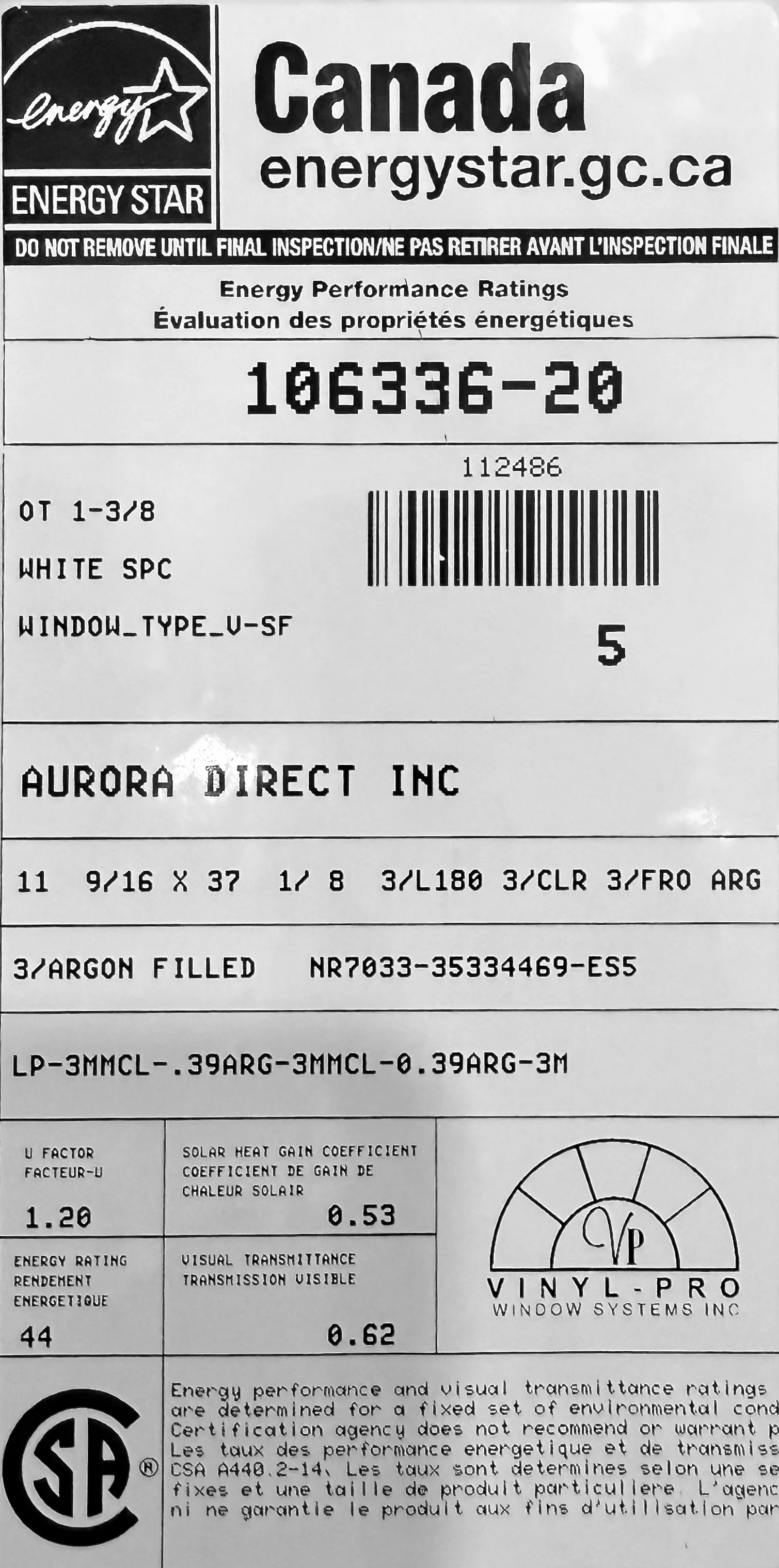
U-Factor: 1.20
Metric value (W/m²·K). Lower is better for insulation.SHGC: 0.53
Solar Heat Gain Coefficient. Higher allows more free solar heat in winter.ER: 44
Energy Rating. Higher is better (balances U-factor, SHGC, and leakage).VT: 0.62
Visible Transmittance. 62% of daylight passes through.VinylBilt Windows
Slider Series
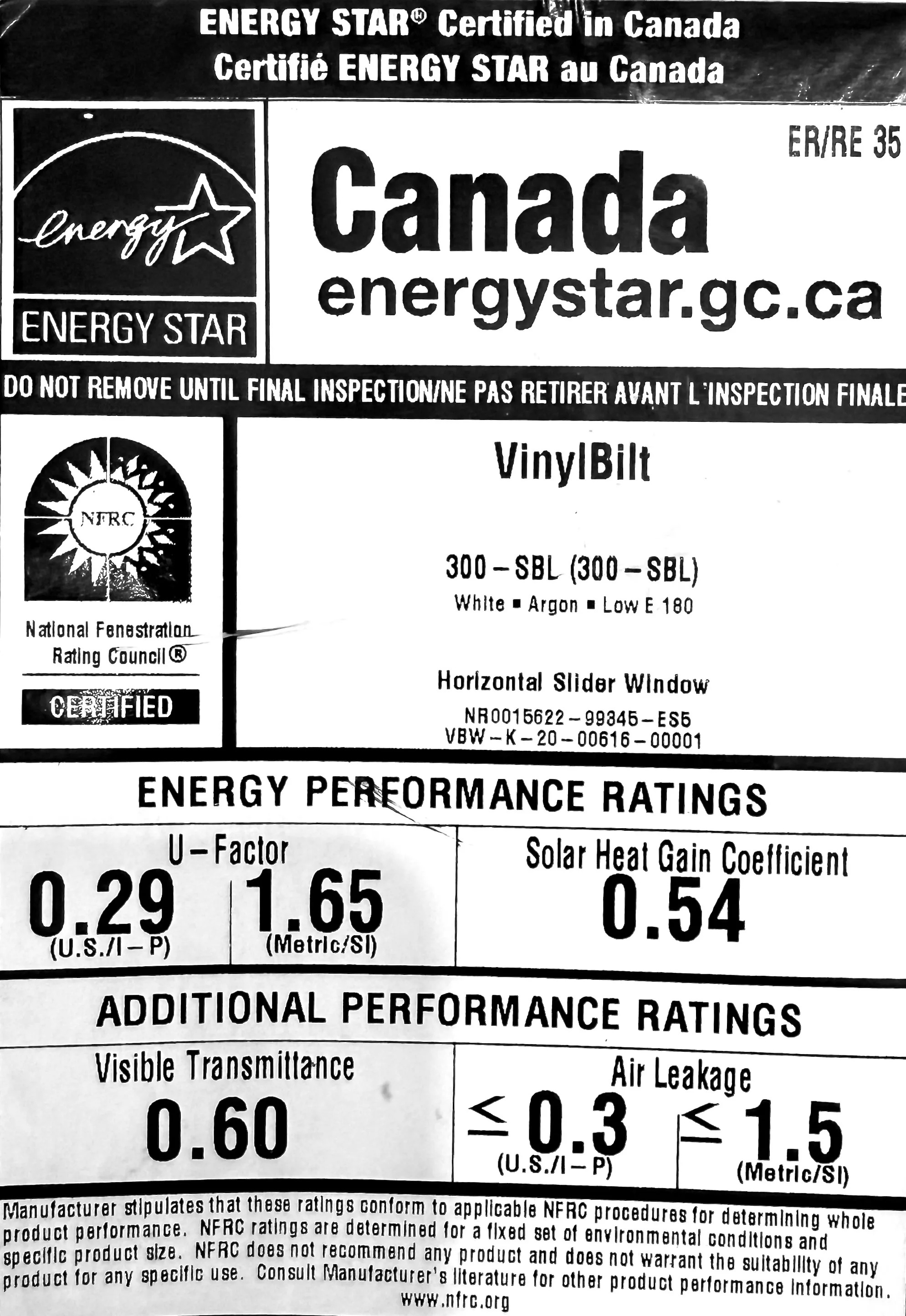
U-Factor
0.29 (Imperial) / 1.65 (Metric). Shows insulation performance.SHGC: 0.54
Solar Heat Gain Coefficient.VT: 0.60
Visible Transmittance.Air Leakage
<0.3 (Imperial) / <1.5 (Metric). Indicates airtightness.ER: 35
Energy Rating. Higher is better (balances U-factor, SHGC, and leakage).Hover over or tap the highlighted areas to learn more about each metric.
Selecting Options for Your Home
Glazing Packages
- • Double vs Triple Pane: Triple‑pane (ER 44+) keeps interior glass warmer, reduces condensation, and provides noticeable street‑noise reduction
- • Low-E Coatings: Advanced Low‑E coatings (often two layers in triple‑pane) optimize for Canadian climates
- • Gas Fills: Argon or Krypton between panes; triple‑pane has two chambers for better insulation
- • Laminated Glass: Available upgrade for security and additional noise control; stays adhered when broken
Orientation & Climate
- • Sun-Exposed: May benefit from lower SHGC to reduce overheating
- • Cold, Shaded: Prioritize U-factor and ER for heat retention
- • Frame Type: Hinged windows seal with compression; sliders rely on track design
- • Ventilation: Pair fixed units for tightness with operables for airflow
Important Certification Information
Not all configurations are certified: Product families can include specific models/options that are ENERGY STAR certified; others may not be. We'll help you select certified choices and show labels.
Compliant wording: "Models are available that are ENERGY STAR certified. Ask to see certified configurations and labels."
Symbol usage: The ENERGY STAR symbol must be used only as permitted (size, color, clear space) and never modified. Product labelling follows NRCan's fenestration requirements.
Official Resources
Frequently Asked Questions
Is ER 30 still ENERGY STAR certified?
No. ER 30 does not meet the current ENERGY STAR Canada minimum requirement of ER 34. If a contractor quotes an 'ENERGY STAR' window with ER 30, they are using outdated information.
How much will I save with higher ER windows?
Moving from ER 34 to ER 44+ typically yields modest bill savings (~$65–$135/year for a typical detached, electric‑heated home). The primary benefits are comfort, condensation resistance, noise reduction, and rebate eligibility.
Are all your windows and doors ENERGY STAR certified?
Some configurations are; certification depends on the exact model and options. We'll help you select certified choices and show you the labels for verification.
What's the difference between U-factor and ER?
U-factor measures heat loss only; ER (Energy Rating) balances heat loss, solar gain, and air leakage for a comprehensive Canadian context. ER is specific to windows.
Will triple pane make my home darker?
It can reduce VT (Visible Transmittance) slightly, but modern glass choices can balance clarity, comfort, and efficiency. We'll help you choose the right option for your needs.
Are triple‑pane windows more secure?
Yes. Triple‑pane windows are heavier, stiffer, and require more force/time and create more noise to break. For maximum security, specify laminated glass on one pane - it stays adhered when broken, like a car windshield.
How do I verify a product is ENERGY STAR certified?
Check the official ENERGY STAR certified products list on the NRCan website using the model/series number. We'll provide all certification documentation with your quote.
Ready to Choose ENERGY STAR Products?
Our experts will help you select certified configurations that maximize efficiency and comfort for your home.